

Managed IT and break-fix support differ mainly in how ongoing work is assigned and paid for. Managed IT usually establishes continuing responsibility for agreed services under a recurring arrangement. Break-fix support involves separately authorized repairs or troubleshooting, commonly billed by time or project.
For Shreveport and Bossier City businesses, we recommend comparing those responsibilities before comparing prices. A monthly fee does not prove that maintenance is happening, and separately scoped repair work does not mean a provider cannot deliver good security or preventive support.
Compare the support arrangement, not a stereotype
Both models can be useful. Our managed IT services address ongoing technology needs, while computer repair can address a specific equipment or troubleshooting problem.
The distinction becomes clearer when you compare the same questions:
Who initiates the work?
In a managed arrangement, the agreement should identify recurring checks and actions the provider is responsible for initiating. Under break-fix, the business commonly identifies a need and authorizes a job.
Either model can include scheduled maintenance if the parties agree to it. The important question is who owns the work between incidents.
What is covered by the price?
A recurring fee covers the services and assets listed in the agreement. Projects, licensing, replacement equipment, specialist recovery, or certain visits may remain separate.
A repair quote covers its authorized scope. Diagnosis, parts, additional faults, or follow-up maintenance may need further approval. Neither price should be treated as an all-inclusive figure without checking the terms.
Who owns an unresolved problem?
A managed agreement should explain who follows an incident through escalation and recovery. A repair job should identify what counts as completion and what happens if diagnosis points to a different system or vendor.
The billing model alone does not answer either question.
Choose around the work that stops when technology fails
Business dependence on technology is more useful than employee count alone. A small office may be unable to schedule, invoice, or serve customers when one shared application fails.
Consider two hypothetical situations:
- A workstation fails, but an approved spare lets the employee continue. A clearly scoped repair may address the immediate need while the business retains responsibility for maintenance and security.
- A shared application failure stops work across two offices. That dependence warrants evaluating ongoing oversight, documented escalation, and recovery responsibilities, whether delivered through managed or a carefully defined hybrid arrangement.
For each critical workflow, record the systems it needs, how long an interruption is tolerable, and who makes decisions when it fails. Then ask each provider to explain how its proposed arrangement supports that workflow.
Do not assume that managed support is always the right answer or that break-fix will always cost less. The environment, existing internal skills, interruption tolerance, and actual service scope determine the fit.
Put maintenance, security, and backup ownership in writing
The UK's National Cyber Security Centre guide to choosing a managed service provider recommends spelling out included and excluded services, responsibilities, and incident reporting in the contract. Use those questions to compare the actual offers, rather than treating a recurring fee as proof of complete coverage.
Ask who is responsible for:
- Updates to supported computers, servers, network equipment, and applications.
- Reviewing security alerts and taking approved corrective action.
- Managing user access and administrative accounts.
- Checking backup failures and completing restore tests.
- Maintaining configuration records and vendor contacts.
Monitoring and corrective work are separate duties. An alert can be recorded without anyone being contracted to fix its cause. A managed proposal should make that distinction clear; a break-fix arrangement should identify who notices and authorizes the necessary work between visits.
Our background discussion of managed IT and cyberattack prevention covers the role of ongoing controls. A proposal still needs to explain which controls are included and who operates them.
Separate successful backups from usable recovery
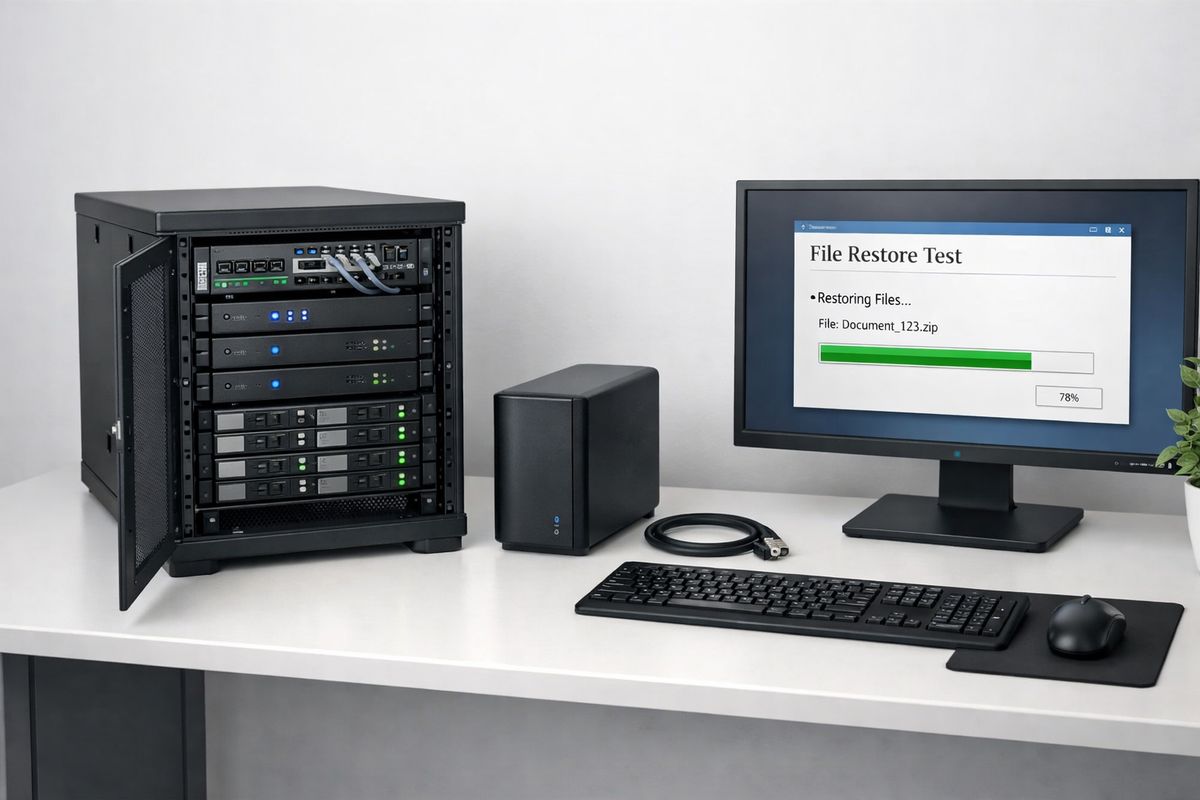
A backup job completing does not demonstrate that the business can restore an application and use its data. Identify who approves and performs recovery tests, what gets tested, and who checks the business result.
Recovery time objectives describe target restoration times. Recovery point objectives describe acceptable data-loss intervals. Both depend on the system, backup design, dependencies, and tested procedures; neither should be treated as a guarantee merely because it appears in a quote.
These responsibilities can exist under either support model. They need named owners and evidence, not an assumption that someone else is handling them.
Compare costs over the same period and scope
For break-fix, include planned maintenance, incident labor, quoted visits or after-hours charges, parts, licensing, and any recovery work. For managed IT, include recurring fees plus onboarding, projects, licensing, equipment, and other excluded work.
Include business interruption only where your records support the estimate. Avoid counting the same loss twice through staff time, lost revenue, and recovery labor.
A hypothetical incident affecting 15 employees for two hours creates 30 affected staff-hours. It does not automatically mean all 30 hours were unproductive: some work may continue offline or shift to other tasks.
Use your incident history, invoices, and actual business impact to compare a reasonable range of outcomes. Separate first-year transition costs from later recurring costs. Do not assume fewer incidents, a particular saving, or a financial return without evidence.
Check remote work, site visits, and coverage hours
Account access and software configuration can often be handled remotely. Physical faults, cabling, and equipment replacement may require someone onsite.
For Shreveport and Bossier City operations, local availability matters when a visit is necessary. Proximity alone does not establish that dispatch, travel, or onsite labor is included in the agreement.
Ask how each provider handles:
- A routine request during staffed support hours.
- A critical service outage requiring technical engagement.
- A fault that cannot be resolved remotely.
- An alert outside the agreed human support window.
- A problem controlled by an application or internet-service vendor.
Continuous monitoring is not automatically continuous staffed assistance. The quote should distinguish automatic detection, human review, technical work, and escalation.
Read service targets carefully
First response, technical engagement, escalation, workaround, and resolution describe different events. An automated acknowledgment does not demonstrate that someone has begun troubleshooting.
A service-level agreement (SLA) should define the target, applicable incident priorities, support hours, measurement rules, and any agreed exclusions or pauses. Check what happens while a provider waits for your approval or another vendor.
Ask whether a stated time is a contractual target, an estimate, or a guarantee, and what evidence supports it. Do not assume service credits, cancellation rights, or remedies unless the agreement says they apply.
Use the same hypothetical critical outage with both providers. Compare the path from reporting to recovery, including the dependencies each provider cannot control.
Use one checklist on both proposals
Before choosing, obtain written answers for:
- The same users, devices, locations, applications, and security needs.
- Recurring maintenance, backup review, restore testing, and incident ownership.
- Remote, onsite, after-hours, and separately charged work.
- Response definitions, escalation routes, and completion checks.
- Projects, hardware, licenses, onboarding, and inherited problems.
- Contract length, renewal, price changes, termination, and exit assistance.
- Business access to its own accounts and documentation.
An unanswered item is an unresolved comparison, not an automatic inclusion.
Choose one workflow your business cannot comfortably interrupt and bring it to the next support conversation. Ask what work the proposal includes, what requires separate authorization, and who remains accountable between incidents.
To discuss the support model that fits your Shreveport or Bossier City operations, Contact Us.