

For businesses in Shreveport and Bossier City, verifying a vendor bank-details change starts with one rule: a legitimate invoice does not authenticate a new payment destination. We need independent authorization, appropriate bank checks, and a documented approval before money moves.
What verifying a vendor bank-details change must establish
Verifying a vendor’s changed bank details means independently confirming that an authorized supplier representative approved a specific new payment destination before we change our records or release payment.
Bank details include the beneficiary or account-holder name, account number, routing number, and applicable international identifiers. Familiar email threads, correct invoices, and matching purchase orders establish neither authority nor account legitimacy.
We verify every change. Urgency, altered contact information, unusual payment methods, and requests near payment deadlines trigger escalation, but none is required to trigger verification. Our first action is to hold the requested change and affected payment while opening a dated verification record.
How we verify the request through a trusted supplier contact
A callback must confirm authority and the exact change
Following the FBI Internet Crime Complaint Center’s (IC3) payment-change verification guidance, we use a number from a previously verified supplier record or independently established relationship. We never source it from the request, attachment, signature, or follow-up.
Our script separates authority from payment instructions:
“Our payment-change policy requires independent confirmation. Please state the name, role, and authority of the person authorizing this change.”
“Please confirm the affected supplier account, effective date, and invoices.”
“Please provide the new beneficiary name and payment details through our approved secure process so we can compare the complete instructions.”
Confirmation that an email was sent is insufficient. We never request passwords, authentication tokens, or bank one-time passcodes.
An unavailable or suspect contact means the hold stays
An unavailable contact requires another trusted callback attempt. A departed contact requires replacement onboarding. Suspected compromise requires a different, independently established channel.
We establish replacements through an existing contract owner or independently corroborated corporate channel. A newly supplied number or website alone is insufficient. Without a trustworthy route, we retain the hold and escalate internally, rather than defaulting to either destination. We complete the independently sourced callback before approving the change.
What bank-account checks prove, and what still needs authorization
Format, account status, and ownership answer different questions
We distinguish three checks rather than treating “validated” as a single result.
- Format and routing checks establish structural validity or identify a financial institution. They do not establish account ownership.
- Account-status checks provide available existence or status information. They do not authorize redirecting a payment.
- Ownership or name checks assess the beneficiary relationship within the bank or provider’s coverage. They do not establish the requester’s authority or business purpose.
For vendor automated clearing house (ACH) payment information, we combine independent authorization with available bank checks. Neither replaces the other. A successful small test payment demonstrates delivery, not authorized ownership.
A different legal entity requires a separate exception review
Payment to another legal entity is not a routine account update. We require documented commercial justification, authorization from the existing supplier’s authorized representative, independent verification of the proposed beneficiary, and finance or legal review appropriate to the arrangement.
Cross-border details need independent confirmation
We confirm the beneficiary’s legal name, country, currency, account number or applicable International Bank Account Number (IBAN), bank identifier code (SWIFT/BIC), and required intermediary instructions.
Transliteration, trading names, and legal names create differences that need independent documentation. We neither ignore mismatches nor assume every mismatch proves fraud. Our approval requires an authorization decision supported by the appropriate account checks.
Who verifies, edits, approves, and releases payment
Separate responsibilities when staffing permits
We explicitly assign verification, record editing, approval, and payment release. The editor cannot be the sole approver or release payment without independent review.
Our reviewer needs callback evidence and authority to stop payment. We restrict vendor-master and trusted-contact editing and preserve change history: an altered callback number defeats independent verification.
A two-person office needs a compensating review
For example, in a two-person business, the office manager could verify and enter the change while the owner independently reviews evidence and approves release. That is a compensating review, not full separation.
For a sole operator, we recommend arranging an authorized independent reviewer before enabling changed-destination payments. We assign that independent approval gate before processing the change.
When a verified change is ready for payment
One controlled record must support the approval
Our record captures the request date, callback-number source, contact identity and authority, verification result, verifier, approver, timestamps, and exception rationale. We preserve original messages and attachments.
Full banking instructions belong in restricted storage. Shared approval records use masked identifiers, with controlled access to the complete instructions when comparison is required.
Verification has no universal turnaround. Trusted-contact availability, exception review, bank-tool coverage, and payment cutoffs determine timing. A deadline does not remove the hold.
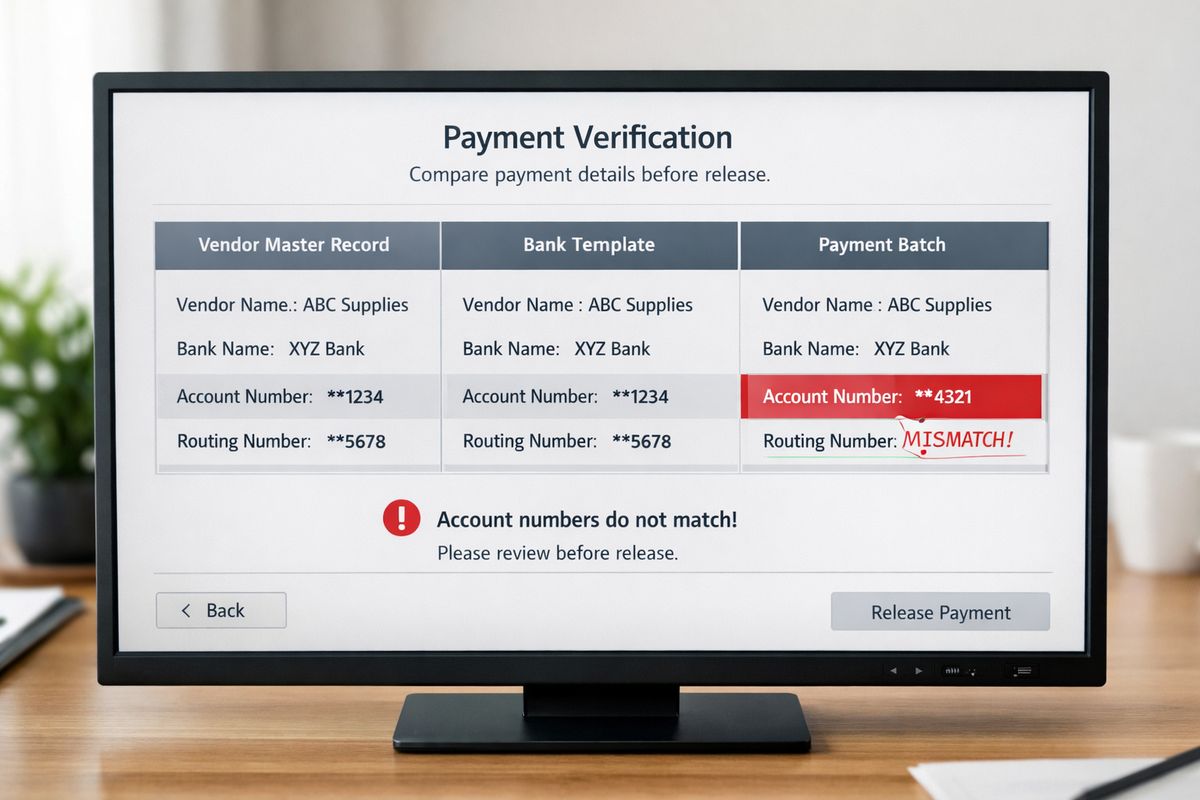
Every payment destination must agree before release
Our release gate covers the vendor master, saved bank templates, scheduled payments, and already-created batches. Updating a master record does not necessarily change an existing payment instruction.
We inspect or rebuild affected pending payments as the system requires. For the first payment, we compare the actual destination against approved evidence. Successful delivery afterward does not retroactively establish authorization. We release that payment only after the cross-system review passes.
A related example, fake Teams IT-support messages, shows why a familiar communication platform is not proof of the sender’s identity.
What we do when the request fails verification or money has moved
Before release, we keep related payments stopped, preserve messages and audit records, and involve authorized finance and security contacts. After release, we immediately contact the originating bank’s fraud team about available recall or restriction options, preserve evidence, activate our organization’s incident-response process, and report through appropriate channels, including IC3.
Email filtering, multifactor authentication (MFA), identity alerts, and automation support verification but cannot authorize payment changes. Our email spam protection supports reducing malicious messages; our cybersecurity training supports practicing escalation. Neither substitutes for the payment-control decision.
This week, we rehearse the verification-and-escalation path using one fictional vendor change, including an unreachable contact and a payment already queued for release.
To review email protection and staff training for a Shreveport-Bossier business, Contact Us.